For any suggestions or feedback regarding these notes,
please contact Pragy Agarwal
k-Nearest Neighbor (k-NN) Queries
Imagine that you're building Zomato, and you've a table called restaurants that holds 100 million entries.
create table restaurants(id bigint primary key,
name varchar(50),
address varchar(200),
latitude real,
longitude real)
Assume that we also have the necessary indexes on the latitude and longitude columns.
Note: modern SQL databases like postgres support geolocation datatypes via extensions (eg, postgis)
Task
Given a user's geolocation (latitude, longitude), you have to find k nearby restaurants.
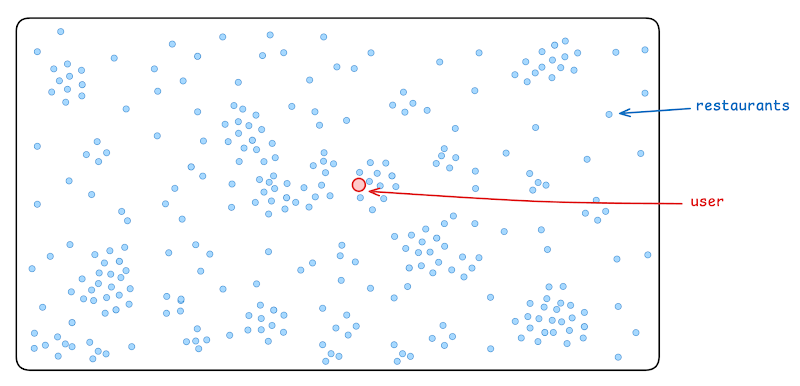
Attempt 1 - find closest k restaurants
select *,
((latitude - user_latitude) * (latitude - user_latitude)
+ (longitude - user_longitude) * (longitude - user_longitude)) as distance
from restaurants
order by distance asc
limit k
note: the formula used is the Euclidean Distance (two point distance) formula
.png)
Q: What is the time complexity of the above query, assuming that the table has N rows, and we've indexes on the latitude & longitude columns?
O(N log k)
- Even though we have the indexes, we cannot use them
- because we're sorting on the distance, and not the latitude/longitude
- this will be a linear scan through the entire table
- Returning top k
- log(k) for the min/max heap
Given an unsorted array of n elements, find the top k ⇒ this takes O(n log k) time
Attempt 1.1 - find all restaurants within a circle
select *,
((latitude - user_latitude) * (latitude - user_latitude)
+ (longitude - user_longitude) * (longitude - user_longitude)) as distance
from restaurants
where distance <= R
limit k
Q: Time Complexity?
O(N)
No sorting/heap needed now.
But we still have to perform a linear scan through the entire table – because the distance formula is complex, and the database cannot use the index to optimize this formula.
A database index is just a sorted array / BBST
You can do lowerbound/upperbound queries (binary search) using an index.
.png)
Circle formulas are complex. Rectangles are simpler!
Attempt 2 - find all restaurants within a square
select *
from restaurants
where user_latitude between ( latitude - L) and ( latitude + L)
and user_longitude between (longitude - L) and (longitude + L)
limit k
.png)
Q: Time Complexity, assuming that we've index on both latitude and longitude columns?
O(log N)
still O(N) worst case! Because you can only use 1 index at a time.
- Database will use the index on latitude to get all the restaurants in the blue region
- Then, it will use the index to get all the restaurants in the yellow region
- DB will take intersection of the two sets
We are still searching through a much larger region than what we actually desire!
Note: this query is better than the circle query, but still not perfect!
.png)
Wait, really? What if we also had a multi-column indices?
- Single column indices
create index idx_lat on restaurants(latitude);
create index idx_lon on restaurants(longitude);
- Multicolumn (composite/joint) indices
create index idx_lat_lon on restaurants(latitude, longitude);
create index idx_lon_lat on restaurants(longitude, latitude);
Unfortunately, even after having multi-column indexes, the search will still remain the exact same! (we will still scan through the blue+yellow region, and then take intersection)
Why though?
Multi-column indexes can perform range queries only on last column!
- can do efficiently O(log N)
- exact queries on any columns
- latitude = X
- longitude = Y
- latitude = X and longitude = Y
- range queries on last column (exact queries on all previous columns)
- latitude = X and longitude between Y1 and Y2
- range queries on a specific column, and include everything in all the other columns to the right
- latitude between X1 and X2, and the longitude can be anything
- can NOT do efficiently
- range queries on both columns
- latitude between X1 and X2 and longitude between Y1 and Y2
Demo - why Composite Index can't do multi-column range queries
Attempt 3 - fixed grid
- First break the world into a fixed sized grid
- For each restaurant, add the cell_id in the restaurants table
.png)
alter table restaurants add cell_id integer;
- we will calculate the cell_id of each restaurant based on its geolocation (lat/lon)
- we will place an index on the cell_id column
- Given the user's geolocation, get the user's cell id
get_cell_id(user_latitude, user_longitude)
- Find all restaurants within that cell
select *
from restaurants
where cell_id = get_cell_id(user_latitude, user_longitude)
.png)
Q: Time Complexity, assuming that we've index on cell_id?
finally, this query will achieve our desired complexity!
O(log N)
Issue
Density of restaurants changes depending on the location.
Some cells have lots of restaurants, some cells have no restaurants.
.png)
So if the user happens to fall in a low density region, we will not be able to find sufficient restaurants for this user.
One approach to fixing this could be to simply expand the search to the nearby cells
select * from restaurants
where cell_id in ( 18, 17, 19, 5, 6, .. ) (surrounding cells)
We don't want a fixed sized grid - we want a Dynamic Sized Grid!
We need a grid that considers the density of the region.
Spatial Index - QuadTrees
Note: There are many other types of spatial indexes.
- Quad Trees (2d spatial index)
- k-D Trees (for higher dimensions)
- GiST
- Geohash
- dozens more!
Visualization: https://kshitijmishra23.github.io/interactive-quadtrees/
- QuadTrees create a dynamic grid. The grid size is based on the density of the region.
- 2D index: index on two columns where you can do range queries on both the columns! (Spatial index)
.png)
QuadTrees provide efficient range queries on 2 dimensions simultaneously!
Unlike regular B+tree indexes, which only work in 1 dimension, quad-trees work in 2 dimensions!
Intuition
- Start with all restaurants in the root node
- If the node contains more than M=10 restaurants, split the node into 4 equal quadrants
- Recurse
M is a configurable parameter
.png)
Each node in the tree must be aware of its coordinates.
.png)
Please practice the QuadTree data structure: Construct Quad Tree - LeetCode
Pseudocode
class Restaurant:
id: int
latitude: float
longitude: float
# the rest of the info will be stored in the db table, and not in the quad tree
class QuadTree:
id: int
top, left, bottom, right: (float, float, float, float)
restaurants: list[Restaurant] # this will be populated
# only for leaf nodes
# it will be empty for intermediate nodes
children: list[QuadTree] # populated only for intermediate nodes
# it will be empty for leaf nodes
def find(self,
latitude: float,
longitude: float) -> list[Restaurant]:
"""given a user's location, finds the restaurants that
fall in the same cell as this location"""
if not ( self.left <= latitude < self.right \
and self.top <= longitude < self.bottom ):
return [] # user's location out of current node's bounds
if not self.children: # we're a leaf node
return self.restaurants
# recurse over children
for child in self.children:
restaurants = child.find(latitude, longitude)
if restaurants:
return restaurants
def insert(self, restaurant: Restaurant):
"""insert the restaurant"""
if not ( self.left <= restaurant.latitude <= self.right \
and self.top <= restaurant.longitude <= self.bottom ):
return # location out of current node's bounds
if not self.children: # we're a leaf node
self.restaurants.append(restaurant)
if len(self.restaurants) > SPLIT_THRESHOLD:
# create 4 new children
# with the appropriate coordinates
# move restaurants to children
...
return
# recurse over children
for child in self.children:
child.insert(restaurant)
def delete(self, restaurant: Restaurant):
"""delete the restaurant from the tree"""
# similar to insert
# find the node
# if leaf remove restaurant from the list
# if parent’s count < SPLIT_THRESHOLD, then go to parent
# and re-join children
# otherwise, recurse on our children
Note that
- inserts can cause an existing leaf node to get split
- deletes can cause an existing intermediate node to get merged.
.png)
.png)
Also note that a leaf node need not always contain M restaurants.
It is possible for a leaf node to be empty.
.png)
If a user happens to fall in a cell which doesn't contain any restaurants, how will we find the relevant restaurants?
- expand the search to the parent node
- easy - just go to the parent node, and find all restaurants within it (from all children)
- expand the search to the neighboring nodes
- much more complex - because neighboring nodes need not come from immediate parent
- however, it can be done efficiently
.png)
- All Nearest Neighbours via Quadtrees
- Constant Time Neighbor Finding in Quadtrees
- Advanced Octrees 4: finding neighbor nodes | The Infinite Loop
- If you find that situations like this are happening very frequently, then this simply means that you've a bad value of M - try to increase the split threshold
Time Complexity for QuadTree operations
O(log4 N) where N is the number of entries in the quadtree
Note that this is the average complexity of insert/delete/find
The worst case can be very bad up to O(N) because the tree can get skewed — but practically this is unlikely to happen.
.png)
Practically, the complexity still remains O(log4 N)
Storing a QuadTree
If we have 100 million restaurants, how large (in bytes) will the quadtree be?
class Restaurant:
id: int
latitude: float
longitude: float
# note that other details about the restaurant will not
# be stored within the quad tree
# they will be stored in the SQL table
class QuadTree:
id: int
top, left, bottom, right: (float, float, float, float)
restaurants: list[Restaurant]
children: list[QuadTree]
.png)
Number of nodes
Only the leaf nodes will store the restaurants. Intermediate nodes do NOT store the restaurants.
(overestimating the number of nodes)
Assume each leaf node stores 1 restaurant on average..
- some leaf nodes have a lot of restaurants – up to M=10
- some leaf nodes are completely empty
But we can assume that each leaf has at least 1 restaurant on average.
.png)
Total nodes
.png)
.png)
Total Space
.png)
We will need around 12 GB to store a quadtree with 100 million restaurants
Do we need Sharding?
Absolutely not!
11 GB is actually small enough to fit in the RAM
Typical production servers can have up to 64GB of RAM easily..
A single server can hold the entire quad tree to store 100 million nodes.
Because the complexity of operations is O(log4 N) and all operations are happening purely in the RAM, the single server will be able to handle 10,000 - 100,000 operations / second!
What about durability? What happens if the quadtree server crashes?
The quadtree is not storing any additional info - every piece of info that it needs is already present in the SQL db.
If the server crashes, we can just spin up another QuadTree server and rebuild the tree from scratch
Rebuilding the entire tree will be an O(N log4 N) operation - it will only take a few seconds at max to rebuild.
N = 100M
N log4 N = 100M * 13.xyz
210 = 1024 ~ 1000 = 103
210 ~ 103 (1K)
220 ~ 106 (1M)
226 ~ 64M
227 ~ 128M
log2(100M) ~ 26.xyz
log4(100M) ~ 13.xyz
Mandatory Assignment (DSA)
Construct Quad Tree - LeetCode
Resources on QuadTrees (optional)
- Theory: CMU notes - quadtrees.pdf
- Visualization
- Generalizations (k-d trees): k-d tree - Wikipedia
- Other uses (collision detection / simulations):
.png)
- 2D Collisions with Quadtree test
- Quadtrees and The Barnes-Hut Algorithm: The Making of a Gravity Simulation
- Proximity services: FAANG System Design Interview: Design A Location Based Service (Yelp, Google Places)
GeoHash
- Explanation
- Code: Geohash encoding/decoding
- Converter: Geohash Converter
- Support in MySQL: Spatial Geohash Functions
- Proximity services: FAANG System Design Interview: Design A Location Based Service (Yelp, Google Places)